
ESA-related Projects and Campaigns

The Climate and Atmosphere Research Center (CARE-C) at the Cyprus Institute has developed strong expertise in the use of satellite observations for atmospheric composition analysis, emissions estimation, and air quality modelling. Through participation in ESA-funded projects such as META-Sat and World Emission, as well as related Earth Observation activities, CARE-C contributes to advancing methodologies that integrate satellite data into modelling frameworks. These efforts support improved monitoring, verification, and understanding of emissions and air quality. They also enable analyses at both regional and global scales.
In addition, CARE-C conducts dedicated observational campaigns from Eastern Atlantic to Eastern Mediterranean that provide high-quality reference data for the calibration and validation of satellite instruments on board Earth exploring missions like EARTHCARE and AEOLUS. The campaigns combine advanced ground-based lidar systems with state-of-the-art UAV-mounted sensors. By linking in situ and remote sensing observations, they strengthen confidence in satellite measurements and their use in climate and air quality research.


World Emission – Global Emission Monitoring from Satellite Observations
Funded by the European Space Agency – contract no. 4000137291/22/I-EF
The World Emission project focuses on developing a global emission monitoring service based on satellite observations, combining top-down approaches with traditional bottom-up inventories. The project brings together leading research institutions and industry partners to advance methodologies for estimating emissions from Earth Observation data and translating them into operational products.
Building on expertise from institutions such as LSCE and the European Centre for Medium-Range Weather Forecasts (via CAMS), the project integrates satellite-derived emission estimates with atmospheric inversion systems and compares them against reported inventories to improve accuracy and consistency.
Key contributions include:
- Development of satellite-derived emission estimates for multiple gases and regions
- Integration of top-down (inversion-based) and bottom-up inventory approaches
- Evaluation of emission retrieval and conversion algorithms from Earth Observation data
- Application of methodologies for CO₂ and NOₓ emission verification, including case studies over Cyprus
- Contribution to the development of an interactive web-based emission monitoring platform
The project demonstrates how satellite observations can support the development of operational emission monitoring services, enabling improved verification of national inventories and supporting policy-relevant applications at regional and global scales.
Learn more about World Emission here.


DUST-DN Project, DC3
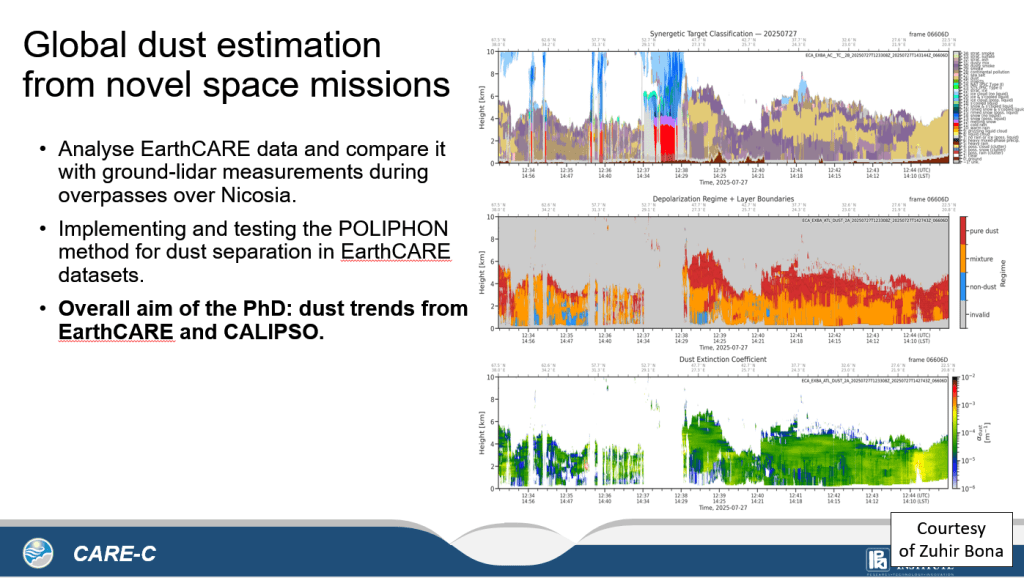
This project has the objective of improving the methods for dust quantification from remote sensing and for establishing a global 4D distribution of dust in the atmosphere. This project utilizes ground-based lidar estimates of the pure-dust atmospheric component determine the concentration and evaluate the pure dust estimates using available datasets from different regions, in particular from airborne in-situ campaigns co-located with lidar; re-evaluate the LIdar climatology of Vertical Aerosol Structure (LIVAS); extend the LIVAS database to the novel spaceborne missions EarthCARE; and globally assess the pure-dust product.
Learn more about DUST-DN here.


AVENGERS – Attributing & Verifying Greenhouse Gas and Aerosol Emissions (Horizon Europe project with ESA-relevant use of satellite observations, including META-Sat and Sentinel-5P / TROPOMI)
AVENGERS aims to improve the verification of national greenhouse gas (GHG) and air pollutant emissions by combining top-down (atmospheric observations and inverse modelling) with traditional bottom-up inventory approaches. The Cyprus Institute contributes by extending these methodologies to the Eastern Mediterranean and Middle East (EMME), a region characterised by complex emissions, limited monitoring infrastructure, and strong natural influences
Building on and extending methodologies developed in META-Sat, AVENGERS applies satellite-based approaches across different pollutants and modelling frameworks, including inverse modelling and emission verification.
Key contributions include:
- Application of inversion modelling frameworks to constrain emissions using atmospheric observations
- Use of satellite observations for methane analyses (e.g. TROPOMI)
- Extension of META-Sat methodologies for NOₓ emission trend estimation and evaluation
- Development of high-resolution emission inventories and comparison with global datasets (e.g. EDGAR, CAMS)
- Analysis of natural vs anthropogenic contributions, including aerosol radiative impacts over the EMME
- Design and evaluation of optimal monitoring networks for greenhouse gas observations
Learn more about AVENGERS here.


Cyprus Observations for EarthCARE validation (CORAL) Project
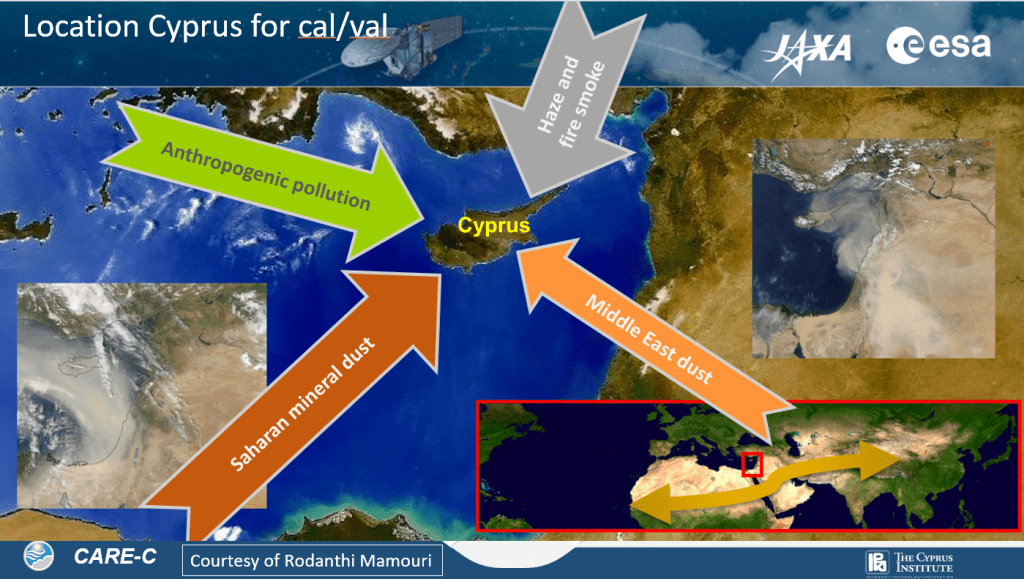
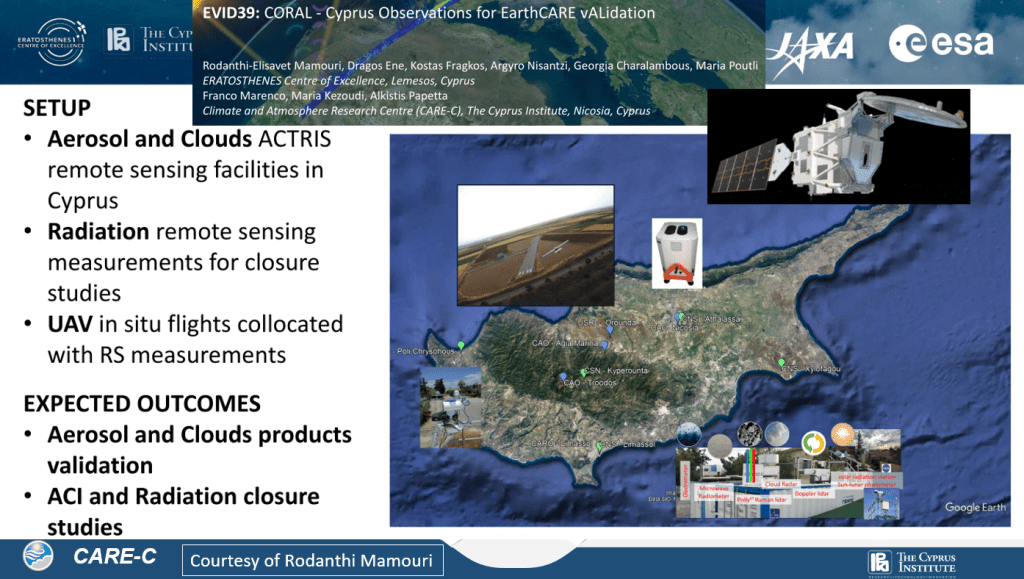
CORAL relies on the synergy and complementarity of the capacity of the two Centres of Excellence based in Cyprus, the ERATOSTHENES Centre of Excellence (ERATOSTHENES CoE) and the Climate and Atmosphere Research Center (CARE-C) of the Cyprus Institute (CyI), for satellite calibration and validation activities, and provides a full set of observations and expertise on the island. CORAL’s CAL/VAL activities will consist of: continuous monitoring in Limassol and at three Cyprus Atmospheric Observatory locations, collaborating with similar activities in Greece and Europe in the framework of EarthCARE cal/val activities; dedicated campaigns on the island, jointly designed and co-implemented by the CARE-C/CyI and ERATOSTHENES CoE teams using ground-based and airborne observations.


CleanCloud-CHOPIN campaign, October-November 2024, Greece
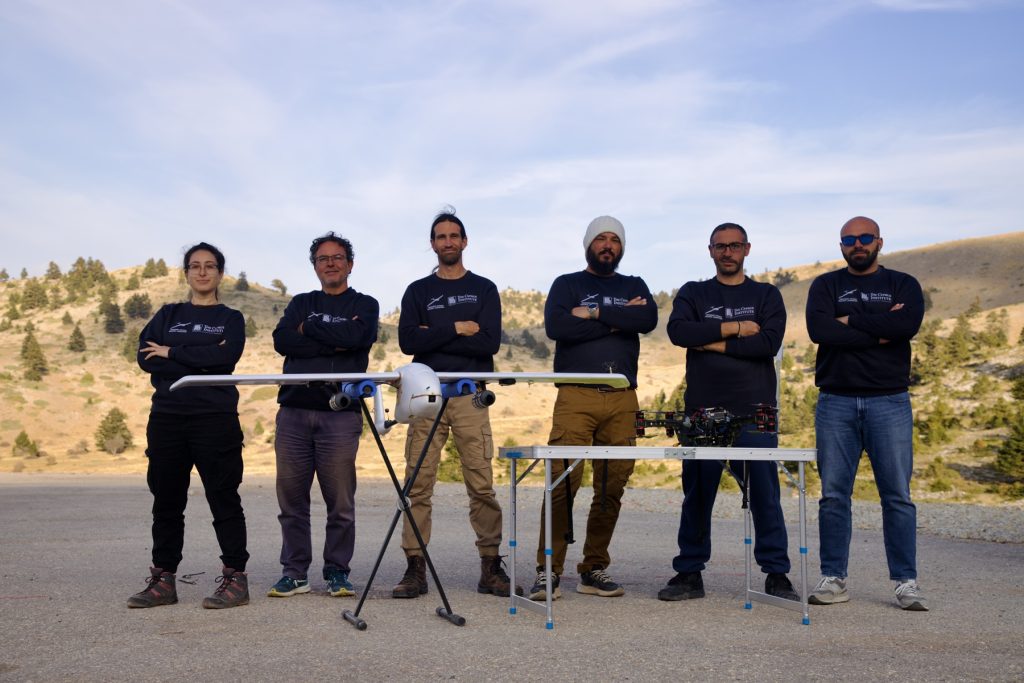
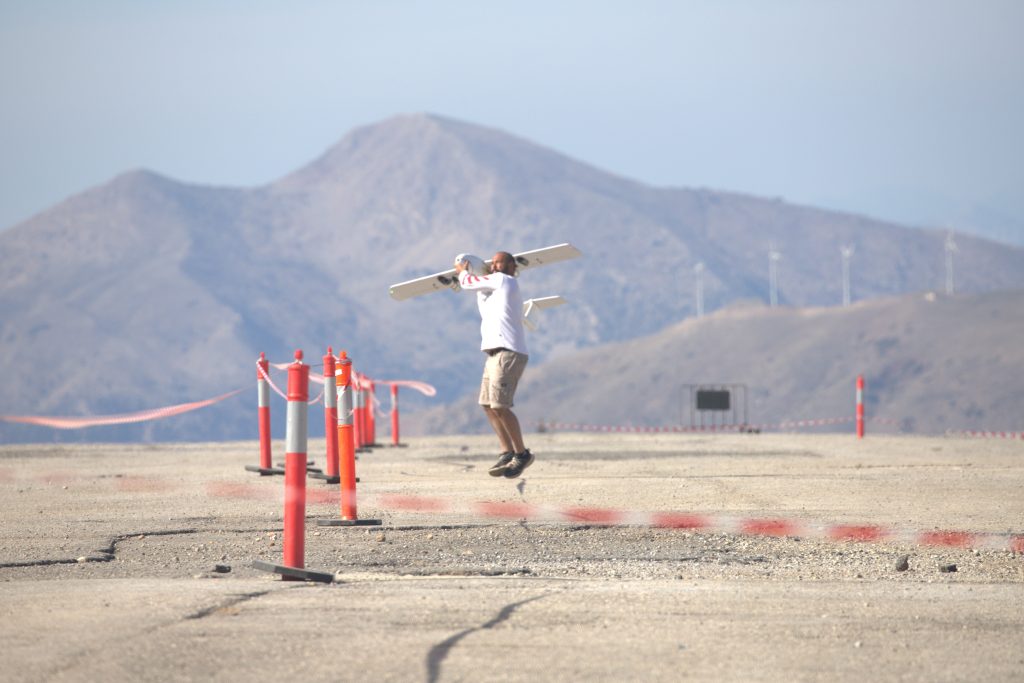
The CleanCloud Helmos OrograPhic sIte experimeNt (CHOPIN) goal is to gain a better understanding of the processes involved in the formation and evolution of mixed-phase clouds and to improve & develop algorithms used for ground-based and spaceborne remote sensing of aerosols, clouds and their interactions. Observations from CHOPIN will also be used to evaluate EarthCARE (ESA-JAXA project) aerosol and cloud retrievals. CARE-C contributed by performing UAV-flights carrying scientific equipment to measure physical and chemical properties of dust.
Learn more about CleanCloud here.

CleanCloud is a Horizon Europe Cluster 5 project (Grant Agreement no. 101137639)


ASKOS campaign, June 2022, Cabo Verde
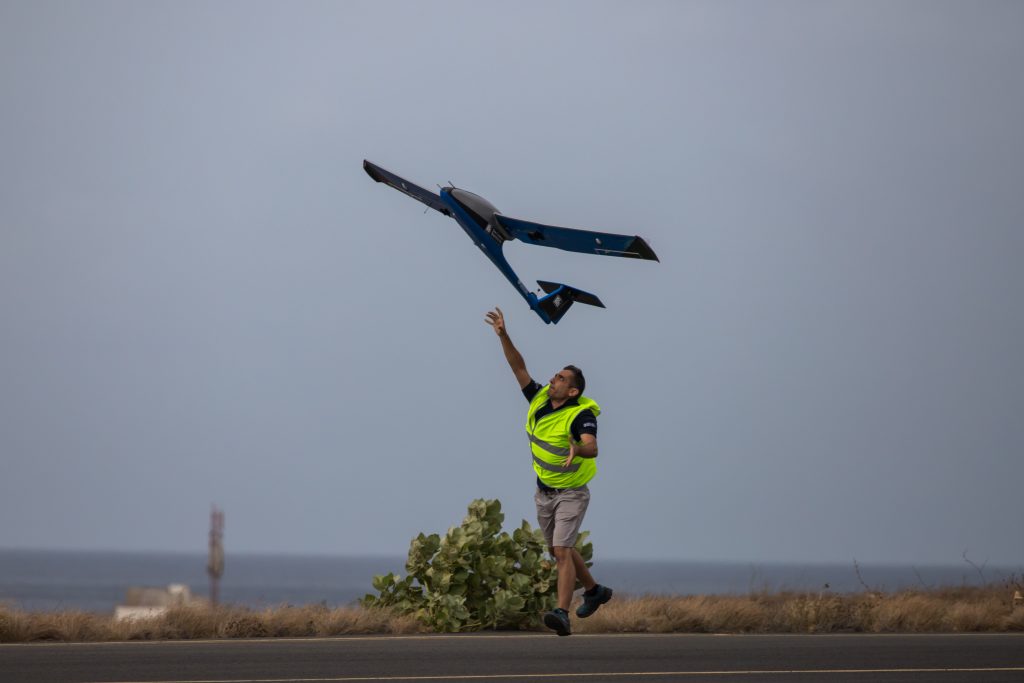
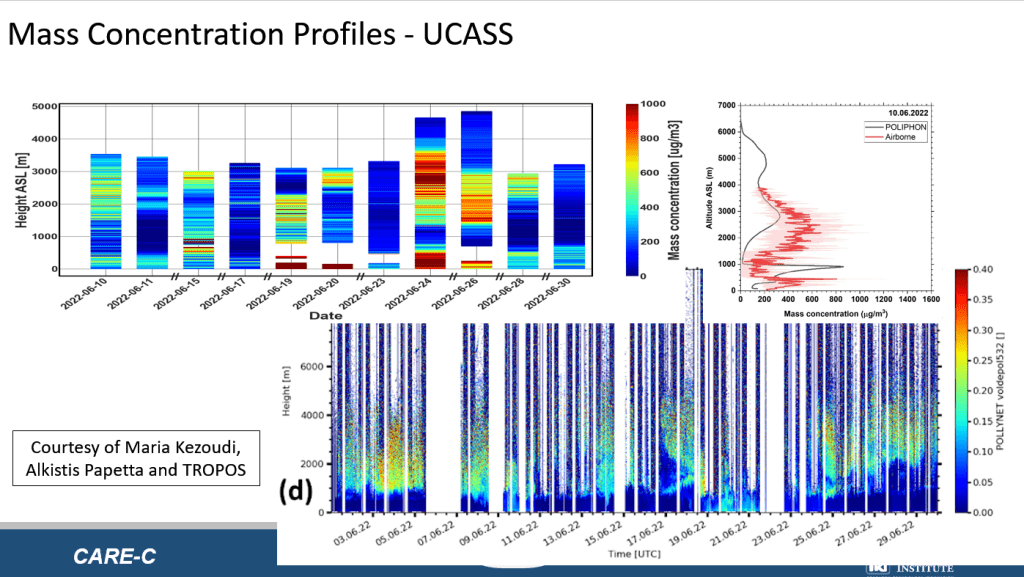
ASKOS (Marinou et al., 2023), the ground-based component of the Joint Aeolus Tropical Atlantic Campaign (JATAC), a campaign organized by the European Space Agency (ESA) and the National Aeronautics and Space Administration (NASA), was implemented by the National Observatory of Athens (NOA) in 2021–2022 in São Vicente, Cabo Verde, to provide reference measurements for calibrating and validating the aerosol products of the Aeolus satellite mission (Fehr et al., 2023).
CARE-C contributed by performing UAV-flights carrying scientific equipment to measure physical and chemical properties of dust.
Learn more about ASKOS here.

Meta-Sat – Modelling of Emissions, Trends and Air Quality using Satellite Measurements
METASAT-ESA Contract No. 4000124009/18/NL/SC (Supported by the European Space Agency, 2018–2020)
META-Sat focused on improving air quality modelling through the integration of satellite observations, with applications in the Eastern Mediterranean and at global scale. The project developed methodologies to derive emission trends from space-based measurements and incorporate them into atmospheric models to improve the representation of air pollution.
A key component of the work was the development of a satellite-driven emission scaling approach, using nitrogen dioxide (NO₂) observations (e.g. OMI) to update emission inventories dynamically. This methodology was applied both regionally and globally, demonstrating its capability to identify discrepancies between reported emissions and atmospheric observations.
Key contributions include:
- Development of a satellite-based emission scaling methodology linking observed NO₂ columns to emission changes
- Production of updated global NOₓ emission datasets (2011–2018) derived from satellite observations
- Application of the methodology in global chemistry-climate models (e.g. EMAC) to assess impacts on air quality
- Quantification of the impact of emission updates on surface NO₂ and ozone concentrations
- Identification of regional emission trends and discrepancies, particularly over major pollution hotspots
The results demonstrated that satellite-derived emission updates can significantly influence modelled air quality, improving the consistency between emissions, atmospheric composition, and observations. This work provided a foundation for producing model-ready, satellite-constrained emission datasets and informed subsequent developments in emission verification and inverse modelling frameworks.

Contact information: office.care-c@cyi.ac.cy