

New model developed to simulate aircraft emissions in airport environments
Researchers of CARE-C, The Cyprus Institute, have developed a new Computational Fluid Dynamics (CFD) air quality model to simulate aircraft emissions during landing and take-off operations in airport environments.
The objective of the model is to capture the dispersion of aircraft exhaust plumes at meter-scale resolution and generate realistic three-dimensional pollution maps. It can help identify emission hotspots within airports, assess exposure for airport workers and passengers, and evaluate the reliability of aviation emission factors.
The model development was led by post-doctoral research fellow Dr. Ioannides, within the framework of the Horizon Europe project NEEDED. The high-resolution Computational Fluid Dynamics (CFD) model is used for air quality applications, focusing on transport-related emissions from road traffic, maritime activity, and aviation.
To develop and test the model, air quality measurements were conducted near runway points at Rotterdam The Hague Airport in the Netherlands, during July-August 2025. These observations provided real atmospheric concentrations of pollutants commonly emitted by aircrafts, such as carbon monoxide (CO), nitrogen oxides (Nox) and Particulate Matter (PM), that were used to validate the CFD model.
Similar measurement campaigns have also been performed near the Larnaca International Airport in Cyprus, during December 2025 and January 2026. A comparable model will also be developed and will be validated against those measurements to assess the impact of aviation emissions in the local airport environment.
Once validated against observations, the model can be used with confidence to support more reliable assessment of aviation emissions and their impact in the airport environment and help identify areas where mitigation measures may be needed.
The NEEEDED project is funded by the European Union’s Horizon Europe research and innovation programme under GA no. 101095754.
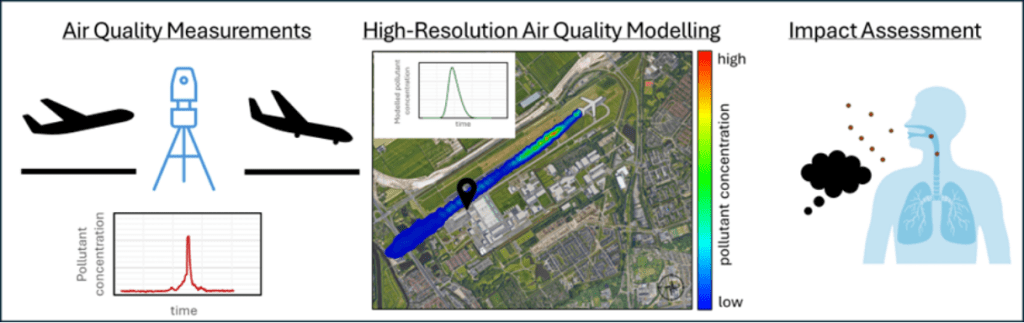
Aircraft take-off and landing cause pollution spikes measured at the airport. A high-resolution model simulates aircraft exhaust plumes, validates them with measurements, and assesses their spatial impact and human exposure.

Funded by the European Union’s Horizon Europe research and innovation programme under GA no. 101095754.